🐵Monkey Face
Animals & Nature Emojis
Mammals, birds, reptiles, sea life, bugs, flowers and plants. Open any animal for its meaning, slang uses and how people use it in captions. There are 161 emojis in 8 subcategories. Tap an emoji to copy it, or open its page for the meaning, examples and technical details.
Animal Mammal (66)Animal Bird (22)Animal Amphibian (1)Animal Reptile (8)Animal Marine (18)Animal Bug (17)Plant Flower (12)Plant Other (17)
🦧Orangutan
🐶Dog Face
🦮Guide Dog
🐕🦺Service Dog
🐩Poodle
🦝Raccoon
🐯Tiger Face
🐆Leopard
🐴Horse Face
🫎Moose
🦓Zebra
🦬Bison
🐮Cow Face
🐂Ox
🐃Water Buffalo
🐷Pig Face
🐖Pig
🐗Boar
🐽Pig Nose
🐏Ram
🐪Camel
🐫Two-hump Camel
🦙Llama
🦒Giraffe
🦣Mammoth
🦏Rhinoceros
🦛Hippopotamus
🐭Mouse Face
🐰Rabbit Face
🐿️Chipmunk
🦫Beaver
🦔Hedgehog
🐻❄️Polar Bear
🦥Sloth
🦨Skunk
🦘Kangaroo
🦡Badger
🐾Paw Prints
🐓Rooster
🐣Hatching Chick
🐤Baby Chick
🐥Front-facing Baby Chick
🦤Dodo
🦩Flamingo
🦚Peacock
🦜Parrot
🐦⬛Black Bird
🪿Goose
🐊Crocodile
🐲Dragon Face
🦕Sauropod
🦖T-Rex
🐳Spouting Whale
🐠Tropical Fish
🐡Blowfish
🐚Spiral Shell
🪸Coral
🦞Lobster
🦑Squid
🦪Oyster
🐌Snail
Monarch Butterfly
🐜Ant
🐝Honeybee
🪲Beetle
🐞Lady Beetle
🕸️Spider Web
🦂Scorpion
🦟Mosquito
🪱Worm
🦠Microbe
🏵️Rosette
🌺Hibiscus
🌼Blossom
🪻Hyacinth
🌱Seedling
🪴Potted Plant
🌲Evergreen Tree
🌳Deciduous Tree
🌾Sheaf of Rice
🌿Herb
🍁Maple Leaf
🍃Leaf Fluttering in Wind
🪹Empty Nest
🪺Nest with Eggs
Leafless Tree
Guide to Animals & Nature emojis
What is in this category
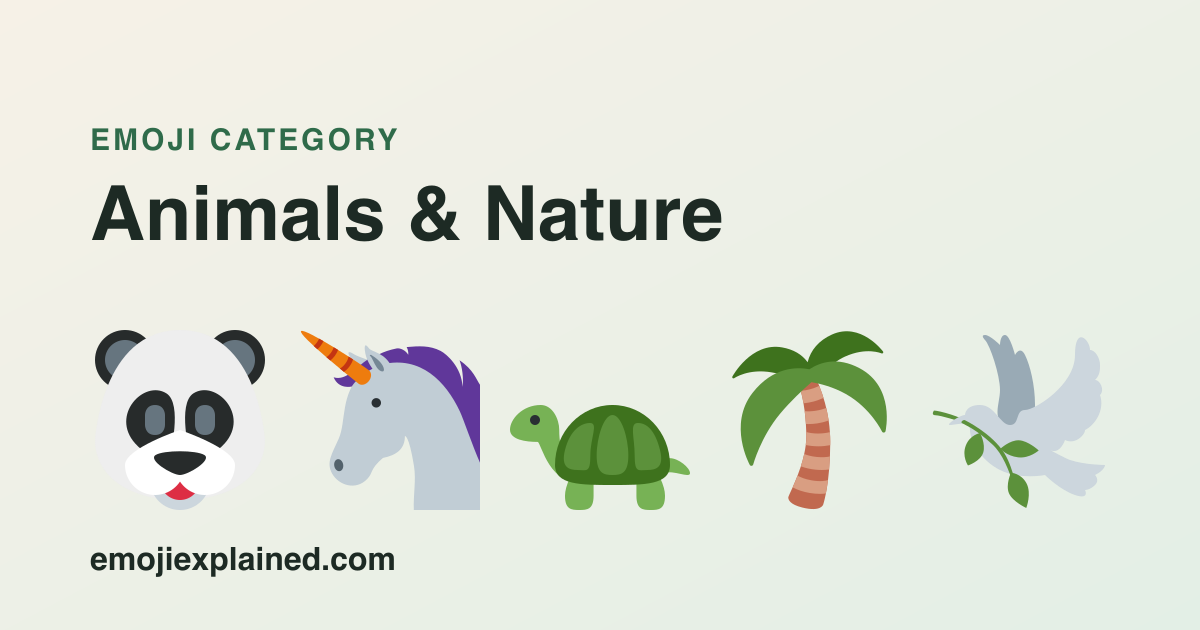
Unicode splits this group into animal mammals, birds, amphibians, reptiles, marine animals and bugs, plus plants split into flowers and other plants. Faces of animals (such as the panda and the cat) and full-body animals are listed together, and a few mythical creatures such as the unicorn sit alongside real ones.
Why people use animals as symbols
Animals carry long-standing meanings that predate emoji: the dove for peace, the turtle for slow and steady progress, the snake for danger or betrayal, the wolf for a lone strong figure. Emoji users borrow those meanings and add online jokes of their own, such as the unicorn for something rare or the shark for a tough business rival. Our pages for the dove, turtle, panda, shark and spider cover those readings.
Things worth knowing
Some animals are shown as a face only and others as a full body, so the panda is a face and the shark is a whole animal. The set also keeps growing with newly added animals each year, including extinct animals such as the dodo and mammoth, added in Emoji 13.0. If a newer animal appears as an empty box on your phone, your device has not been updated for that release.
Meaning pages in this category
We have written full meaning pages for 74 emojis here, with examples, replies and platform notes.
🐒 Monkey🦍 Gorilla🐕 Dog🐺 Wolf🦊 Fox🐱 Cat Face🐈 Cat🐈⬛ Black Cat🦁 Lion🐅 Tiger🫏 Donkey🐎 Horse🦄 Unicorn🦌 Deer🐄 Cow🐑 Ewe🐐 Goat🐘 Elephant🐁 Mouse🐀 Rat🐹 Hamster🐇 Rabbit🦇 Bat🐻 Bear🐨 Koala🐼 Panda🦦 Otter🦃 Turkey🐔 Chicken🐦 Bird🐧 Penguin🕊️ Dove🦅 Eagle🦆 Duck🦢 Swan🦉 Owl🪶 Feather🪽 Wing🐦🔥 Phoenix🐸 Frog🐢 Turtle🦎 Lizard🐍 Snake🐉 Dragon🐋 Whale🐬 Dolphin Orca🦭 Seal🐟 Fish🦈 Shark🐙 Octopus🪼 Jellyfish🦀 Crab🦐 Shrimp🦋 Butterfly🐛 Bug🦗 Cricket🪳 Cockroach🕷️ Spider🪰 Fly💐 Bouquet🌸 Cherry Blossom💮 White Flower🪷 Lotus🌹 Rose🥀 Wilted Flower🌻 Sunflower🌷 Tulip🌴 Palm Tree🌵 Cactus☘️ Shamrock🍀 Four Leaf Clover🍂 Fallen Leaf🍄 Mushroom
Questions about animals & nature emojis
Are plants and flowers in this category?
Yes. Flowers and other plants are subgroups of Animals & Nature.
Why is the panda only a face?
Unicode defines some animals as faces and others as full bodies. The panda emoji is a face.
Why do some animal emojis show as empty boxes?
They were added in a recent Emoji release that your device or app does not support yet.